
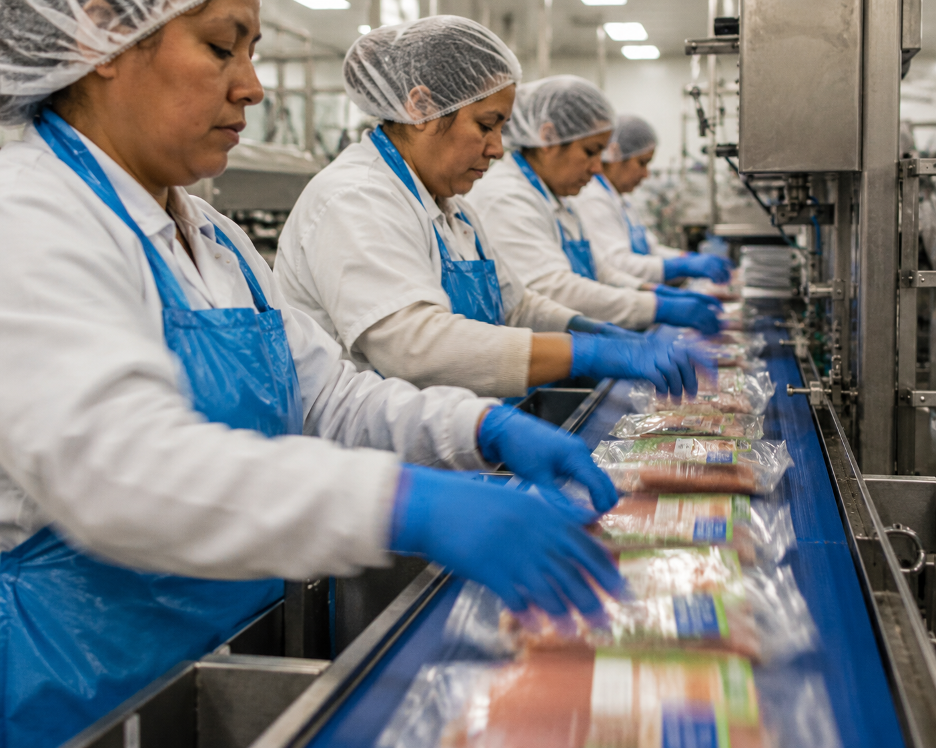
The food production industry is one of the largest employers in the United States—and one of the most challenging from a Workers’ Compensation perspective. Food packaging and processing workers perform physically repetitive tasks at high speed, often in cold or wet environments, with limited ability to adjust their pace or posture. The result is an industry where musculoskeletal disorders and repetitive stress injuries are the norm, not the exception.
Understanding the Work Environment
To appreciate the WC risk in food processing, it helps to visualize a typical workstation. A worker on a poultry processing line may perform the same knife cut or wrist rotation thousands of times per shift. A packaging line employee may lift, orient, and place products at a rate of one every three to four seconds. An operator at a sorting station may stand on a concrete or wet rubber floor for eight or more hours, reaching and turning repeatedly to inspect and redirect product.
Every one of these tasks, performed repeatedly without adequate rotation, rest, or ergonomic support, is a cumulative trauma in the making. The Bureau of Labor Statistics consistently ranks food manufacturing among the industries with the highest incidence of musculoskeletal disorders per 100 workers.
Common Injuries in Food Processing
The injuries that arise from this environment are predictable, which makes them preventable—at least in part:
- Carpal tunnel syndrome: Particularly prevalent in meat and poultry processing where knife work, repetitive gripping, and vibrating tools are constant.
- Tendinitis and epicondylitis: Inflammation of tendons in the arm and elbow from repeated extension and flexion motions.
- Trigger finger: Common in workers who grip and manipulate tools or packaging materials throughout their shift.
- Lower back disorders: Chronic back pain from standing, bending, lifting, and twisting in non-neutral postures.
- Shoulder impingement: Overhead reaching on packaging lines or stacking applications strains the rotator cuff over time.
- Knee problems: Extended standing on hard or wet floors without proper footwear and flooring support accelerates joint degeneration.
Compounding Factors in Food Production
Several factors specific to food processing amplify ergonomic risk:
Cold and Wet Conditions
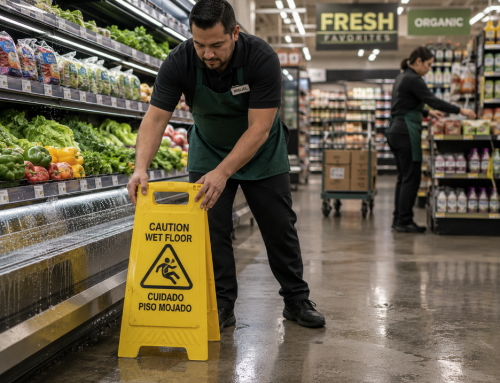
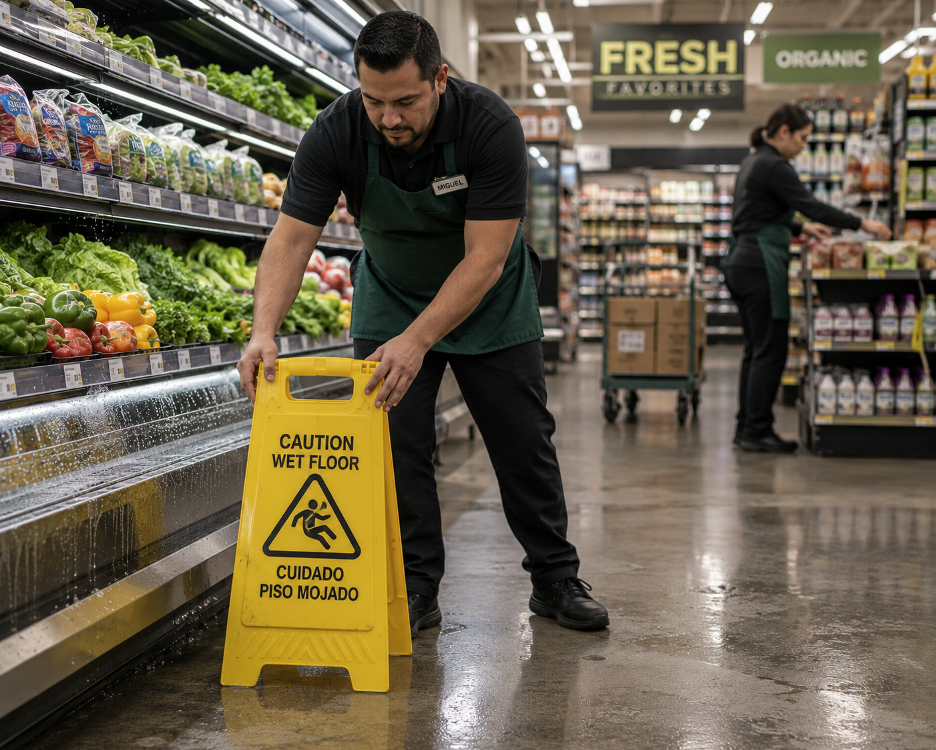
Refrigerated meat processing facilities, seafood plants, and cold-pack operations expose workers to cold temperatures that reduce blood flow to extremities, stiffen joints, and slow the body’s recovery from repetitive stress. Wet floors add a slip risk dimension. Workers may wear heavy gloves that increase grip force requirements, accelerating upper extremity injury.
Production Quotas and Line Speed
Like warehousing, food production workers are often subject to line speeds and quota expectations that limit their ability to self-regulate their pace. Government regulators have raised line speeds in poultry processing, a change that industry safety advocates argue has increased injury risk for workers.
Language Barriers and Training Gaps
Many food processing facilities employ significant numbers of workers for whom English is not a primary language. When safety training and ergonomic instruction isn’t available in workers’ native languages, the effectiveness of those programs is compromised—and injury rates reflect that gap.
WC Risk Reduction Strategies
Brokers can add real value by encouraging food processing clients to invest in:
- Job rotation programs that cycle workers through different tasks to reduce single-motion repetition
- Anti-fatigue matting and appropriate footwear programs for standing-intensive positions
- Tool redesign to reduce grip force and vibration exposure
- Multilingual safety training and injury reporting processes
- Early symptom reporting programs that catch problems before they become surgical claims
Carriers who specialize in food manufacturing understand these dynamics and may offer meaningful loss control resources alongside their WC products.
Comp Central helps brokers find Workers’ Comp markets with the expertise and appetite to cover food processing and packaging operations—including facilities with challenging loss histories that need a knowledgeable underwriting partner.
Contact Comp Central to explore WC solutions for your food production and processing clients.