

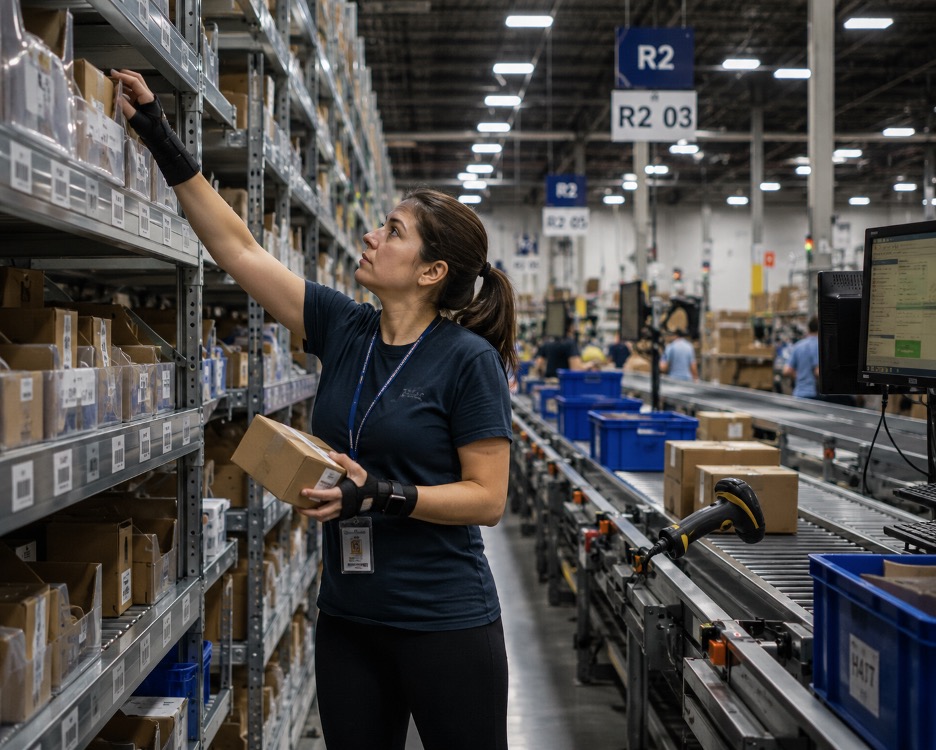
The explosion of e-commerce and same-day delivery expectations has fundamentally changed the warehouse environment. Today’s distribution centers operate at a pace that was unimaginable a decade ago—workers are scanning, picking, packing, and sorting at production rates dictated by algorithms, not human ergonomics. The result is a surge in repetitive strain injuries (RSIs) that is reshaping the Workers’ Compensation landscape for logistics and fulfillment employers.
What Are Repetitive Strain Injuries?
Repetitive strain injuries—also called musculoskeletal disorders (MSDs) or cumulative trauma disorders—occur when muscles, tendons, and nerves are subjected to the same motion over and over again without adequate recovery time. Unlike acute injuries (a forklift accident, a box falling on someone’s foot), RSIs develop gradually and are often ignored until they become debilitating.
Common RSIs in warehousing include:
- Carpal tunnel syndrome from repetitive scanning and packing motions
- Tendinitis and bursitis in shoulders and elbows from overhead reaching or pushing heavy carts
- Lower back strain from repeated lifting, twisting, and bending
- Knee problems from prolonged standing on concrete floors
- De Quervain’s tenosynovitis from constant wrist twisting
Any single one of these injuries, when it leads to surgery and extended time away from work, can generate a five- or six-figure WC claim. And in high-volume facilities, they don’t happen in isolation—they happen in clusters.
Why High-Speed Warehousing Is a Perfect Storm
Several factors specific to modern fulfillment operations amplify RSI risk:
Production Rate Pressure
When workers are measured against algorithmic pick-rate targets, they have little incentive to take breaks, adjust their posture, or slow down to use proper body mechanics. Fear of disciplinary action for missing targets creates a culture where workers push through pain—often until a minor strain becomes a serious injury.
Poor Ergonomic Design
Many warehouses were not designed with ergonomics in mind. Workstations at fixed heights don’t accommodate workers of different sizes. Conveyor speeds are optimized for throughput, not human capacity. Heavy items are stored at floor level, requiring repeated deep bending to retrieve.
High Turnover and Inadequate Training
The warehouse industry notoriously struggles with turnover. New workers—who are statistically at highest risk for injury—are often rushed through orientation and placed on the floor with minimal ergonomic training. The cycle repeats constantly, and each new wave of workers begins accumulating the micro-traumas that lead to RSI claims months later.
Extended Shifts
Overtime, mandatory extra shifts, and back-to-back days without adequate rest are common in distribution centers during peak seasons. Fatigue reduces the body’s ability to recover from repetitive stress, dramatically accelerating injury progression.
The WC Cost Implications for Brokers
RSI claims are expensive and complex. Unlike traumatic injuries with clear causation, cumulative trauma claims often involve disputed onset dates, pre-existing conditions, and arguments over work-relatedness. They take longer to resolve, generate more litigation, and can involve vocational rehabilitation when a worker can no longer perform their original duties.
For brokers, this means warehouse distribution clients—especially those in e-commerce fulfillment—represent significant and evolving WC exposure. Mod scores can rise quickly when RSI claims accumulate, and some carriers have moved away from writing high-velocity fulfillment centers in certain states.
What Brokers Can Do
Proactive brokers can differentiate themselves by helping warehouse clients implement ergonomic programs, track leading indicators (near-misses, workers reporting early symptoms), and build return-to-work programs that reduce claim duration. Carriers respond favorably to clients who demonstrate a safety culture, not just a safety policy.
Comp Central works with brokers to find WC markets that understand high-volume distribution environments and can price the risk appropriately—without penalizing clients who are actively working to reduce injury frequency.
Contact Comp Central to discuss Workers’ Comp strategies for your warehouse and distribution center clients.