

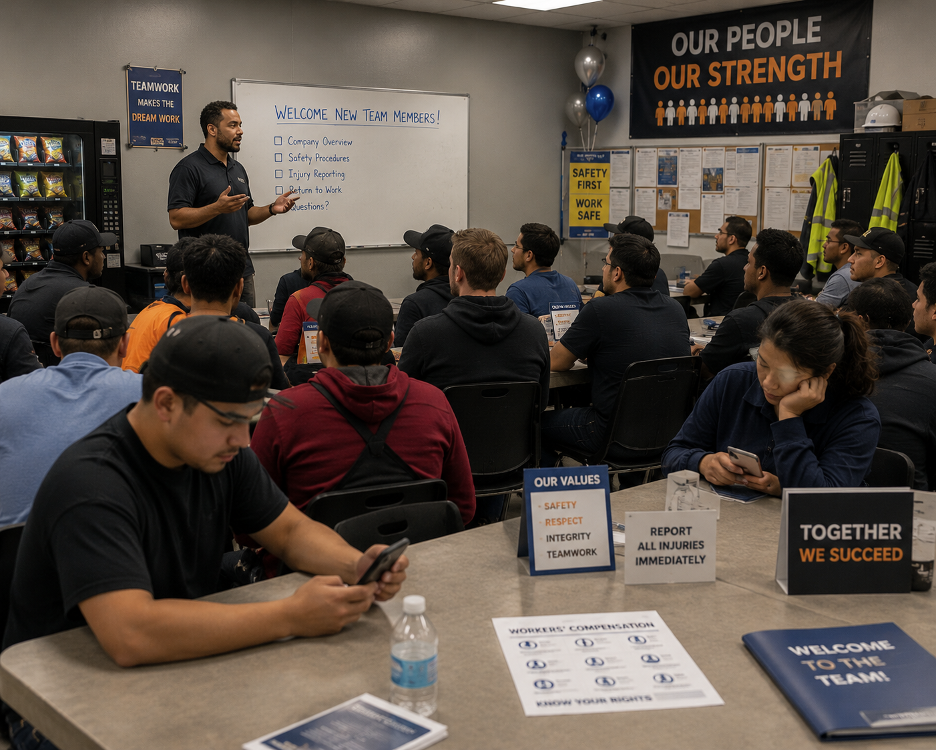
Employee turnover is expensive in obvious ways—recruitment costs, training time, lost productivity. But one cost that often goes unrecognized until it shows up on a renewal quote is the impact of high turnover on Workers’ Compensation. For brokers with clients in retail, food service, warehousing, hospitality, and other high-churn industries, turnover-driven WC instability is a real and growing challenge.
New Workers Are the Highest-Risk Workers
The data is consistent across industries: new employees are injured at significantly higher rates than experienced ones. The reasons are straightforward—they don’t know the hazards, they haven’t developed the muscle memory and situational awareness that come with experience, and they may be reluctant to ask questions or slow down to do things safely when they’re trying to impress a new employer.
In high-turnover environments, the workforce is perpetually new. At any given time, a large portion of the crew may have been on the job for 90 days or less—which is precisely the highest-risk period. For a distribution center running at 100% annual turnover (not unusual in the sector), the safety math is deeply unfavorable. The company is essentially always operating with a partially inexperienced workforce.
The Mod Score Impact
Each injury that generates a WC claim feeds into the employer’s experience modification rate. In high-turnover environments, the frequency of claims often rises even when no single incident is particularly severe. And frequency, as noted in the mod score calculation, is weighted heavily—sometimes more damaging to the mod than a single large claim.
A business that turns over 80% of its workforce annually and experiences proportionally more minor injuries (slips, strains, small lacerations) may find its mod steadily creeping upward, year after year, without ever having a catastrophic event. The cumulative effect of frequent low-severity claims can be just as damaging to insurability as one large catastrophic claim.
Audit Exposure from Fluctuating Payrolls
Workers’ Compensation premiums are calculated on estimated annual payroll, with a year-end audit to true up the final premium. High-turnover businesses often have wildly fluctuating actual payrolls. They may over-hire in Q4 for the holiday rush and run lean in Q1. They may have weekly headcount changes that make the original payroll estimate meaningless by year-end.
When the audit reveals that actual payroll was significantly higher than estimated, the employer receives an audit bill—sometimes a substantial one—at renewal time. Clients who weren’t prepared for this face a cash flow crisis on top of everything else.
Pay-as-you-go Workers’ Comp programs that report actual payroll each pay period are a much better fit for high-turnover businesses. They eliminate large audit adjustments and tie premium payments to actual workforce size in real time.
Training Gaps and Compliance Risk
High turnover doesn’t just mean more new employees—it often means compressed, inadequate training. When a warehouse needs to fill 20 slots before the weekend, the onboarding process gets shortened. Safety training that should take two days gets compressed into two hours. Employees who should be supervised for their first 30 days are put on the floor independently after one shift.
These training gaps are both a WC risk and a regulatory compliance risk. OSHA recordables that pile up in a high-turnover environment attract regulatory scrutiny, and OSHA violations compound WC exposure in ways discussed elsewhere in this series.
Strategies Brokers Can Recommend
Brokers working with high-turnover clients should consider advocating for:
- Structured new-hire safety orientation with documented sign-off before employees begin independent work
- Buddy systems or mentorship pairing for first-week employees working alongside experienced workers
- Pay-as-you-go WC to eliminate payroll audit surprises
- Proactive claims management protocols so that minor injuries are addressed quickly before they escalate
- Quarterly loss runs review to track injury frequency trends by department, shift, or job classification
Comp Central works with brokers to find WC carriers with the appetite and experience to write high-turnover accounts—and to build strategies that help those clients improve over time.
Contact Comp Central to discuss Workers’ Comp solutions for your clients with high employee turnover.